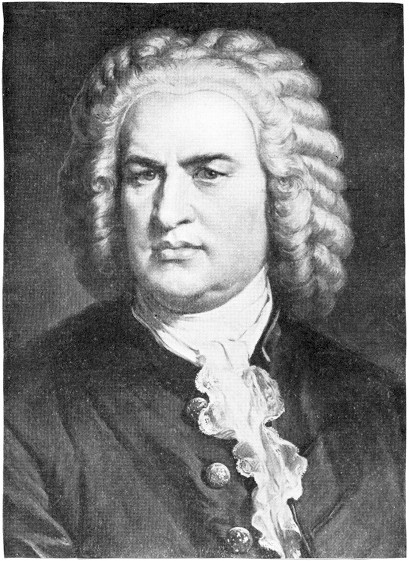
The first composer we will study will be J.S. Bach (1685-1750). I hope you will enjoy this little biography, suitable for all ages:

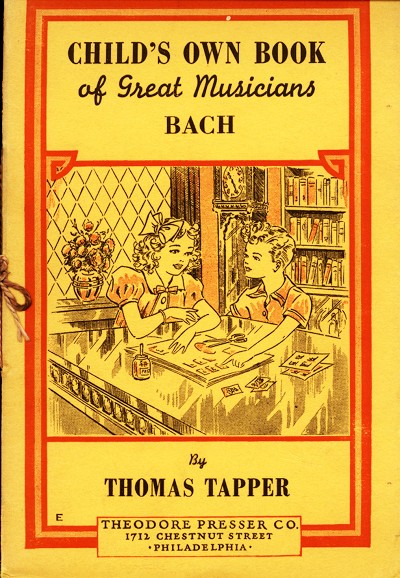
(Isn't this cover adorable? I love retro stuff like this!)
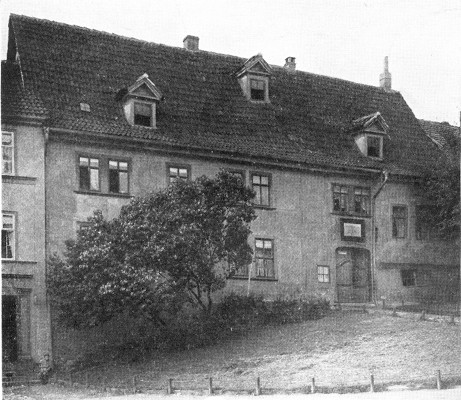
This is the house in which JOHANN SEBASTIAN BACH was born.
This house stands in the town of Eisenach in Germany. It looks very much the same today as it did when Sebastian was a little boy. Many people go there to visit this house because the little boy grew to be a famous man.
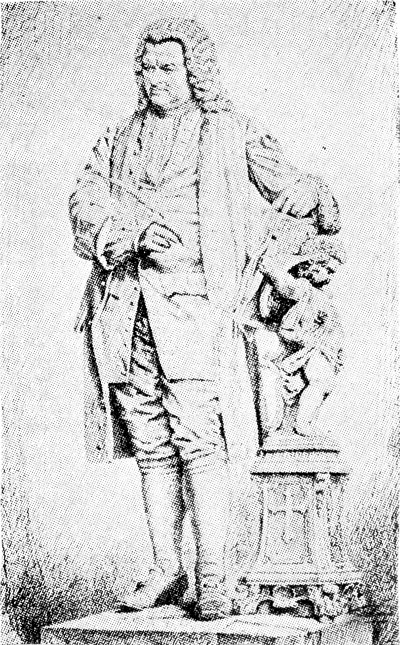
In Eisenach there is a statue of Bach near the palace.
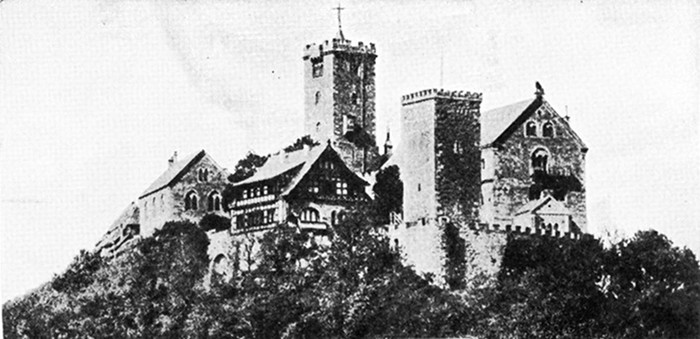
In the same town in which Sebastian was born there stands on the top of a hill a very famous castle built many hundreds of years ago. This castle is called the Wartburg.
As a boy little Sebastian used to climb the hill with his friends, and they, no doubt, had a happy time playing about the castle grounds. In one of its great halls the minstrels of Germany held their Song Contests. When Sebastian was old enough he used to travel afoot, just as the minstrels did; his purpose was to go to hear fine organ players. Once as he sat weary by the roadside someone threw a herring to him so that he might eat as he rested.
 BACH EATING THE HERRING.
Little Sebastian's father was named JOHANN AMBROSIUS BACH. He, too, was a musician, as his people had been for many years.
 JOHANN AMBROSIUS BACH.
One of these was a miller who played and sang while the corn was grinding. His name was Veit Bach, and his little boy was called Hans, the Player, because he, too, loved to play the violin.
 VEIT BACH AND HIS SON HANS.
When Sebastian was ten years old his father and mother died. So he went to live with his brother, whose home was a few miles away. Of this brother Sebastian had music lessons, and he improved so rapidly that he used to beg to be allowed to play the pieces in a big book in the library. But the brother refused him this pleasure. However, little Sebastian was eager to learn all the music he could find, so he used to sit up on moonlight nights and copy these pages while his brother was asleep. But what do you think happened when he had copied everything in that big book? His brother found out what he had done and took all his precious music away from him.
 BACH COPYING MUSIC BY MOONLIGHT.
If you know any boy who is about twenty years old you may say to him, Bach was as old as you are when Benjamin Franklin was born in Boston. And although there was this difference of twenty years or so in their ages, we may think of them at work in the world at the same time. You must remember that all men like Franklin and Bach who became famous did so by working very hard.
 BENJAMIN FRANKLIN.
Franklin, too, was born very poor. Once he walked the streets of Philadelphia with a loaf of bread under each arm. But by being faithful in all he did he became the friend of all his countrymen and of Kings and Queens besides. Benjamin Franklin was quite a little younger than Sebastian Bach. But there was a famous man who was almost exactly Sebastian's age. This man, Georg Friedrich Handel (pictured below), composed Messiah, an oratorio that is loved by everybody. It is sung in cities and towns all over the world, particularly at Christmas time.

Handel's Messiah was first sung in the Irish city of Dublin, 1742. At that time Sebastian Bach was living in Leipzig and had been for many years at the head of the Thomas School. He was known as its Cantor. Bach worked very hard here to supply music for several of the Leipzig churches, and he worked so well that his fame spread until it reached the ears of the Emperor. Frederick the Great was also a musician and composer. So he invited Sebastian Bach to visit him at his castle. There were many people present, but Sebastian Bach was the principal guest. He played on many of the Emperor's fine pianos. When he reached home again he composed a musical work and dedicated it to the Emperor.
 BACH PLAYING BEFORE FREDERICK THE GREAT.
The kind of a piano that Sebastian Bach played on was not called a piano in his day. It was called a Clavier or Clavichord. Some day you will study a collection of pieces by Sebastian Bach which was written for this instrument and was called The Well Tempered Clavichord. This is the kind of piano, or clavichord, that Bach used.
 THE CLAVICHORD.
And here is the beginning of the very first piece in the collection of which we have just spoken in Bach's handwriting.
 MORNING PRAYERS IN THE HOME OF JOHANN SEBASTIAN BACH.
Sebastian Bach had a very large family, twenty children altogether. Two of them studied music faithfully with their father. One was Friedmann, for whom the father wrote a book called Little Preludes. Friedmann's brother, Philipp Emanuel Bach, was a very fine clavichord player. He wrote a book about music and composed many pieces.
 WILLIAM FRIEDMANN BACH.
 PHILIPP EMANUEL BACH.
Sebastian Bach died in 1750. He was sixty-five years of age. Benjamin Franklin was at that time forty-four years old and George Washington was eighteen.
This is the way Bach wrote his name.